Top 15 Things to Do in Marrakech
Marrakech rewards a plan. These are the fifteen things genuinely worth your time in the Red City, in a sensible order, with the practical details most lists leave out.


Marrakech rewards a plan. These are the fifteen things genuinely worth your time in the Red City, in a sensible order, with the practical details most lists leave out.
Marrakech is small enough to walk and dense enough to exhaust you. The medina is a walled maze of perhaps a thousand lanes; the modern city outside it has gardens, galleries and restaurants. Three days is a good stay. Here are the fifteen things worth your time, in roughly the order we would do them, with the practical notes that decide whether each one is a highlight or a hassle.
The main square is a UNESCO-recognised living tradition and also the most aggressively commercial spot in the city. Go at around 18:00, when the food stalls are assembling and the light is good, and again after 21:00 when the drum circles and storytellers take over. Avoid the middle of the day, when it is hot, empty and full of touts. Photograph performers only after agreeing a tip, and be firm and friendly about monkeys and snakes — we would not encourage that trade.
North of the square, the souks run by trade: Souk Semmarine for textiles, Souk Haddadine for ironwork, Souk Cherratine for leather, the dyers’ souk for wool in tanks of colour. Two hours minimum. Prices are negotiable as a matter of course — see our souks and haggling guide before you start. Go in the morning for working craftsmen rather than only sales.
A late nineteenth-century grand vizier’s palace, and the best single building in the medina for understanding Moroccan decorative craft: carved cedar ceilings, zellij tilework, stucco and courtyards of orange trees. Go at opening time; by 11:00 it is full. Allow an hour.
Sealed for centuries and rediscovered in 1917, this small royal necropolis holds the Hall of Twelve Columns, one of the finest interiors in Morocco. It is compact, so it feels crowded quickly. Thirty to forty-five minutes, early.
A fourteenth-century Quranic school, restored and reopened, with a central courtyard of carved cedar and zellij that is arguably more beautiful than the Bahia. Student cells upstairs. Forty-five minutes.
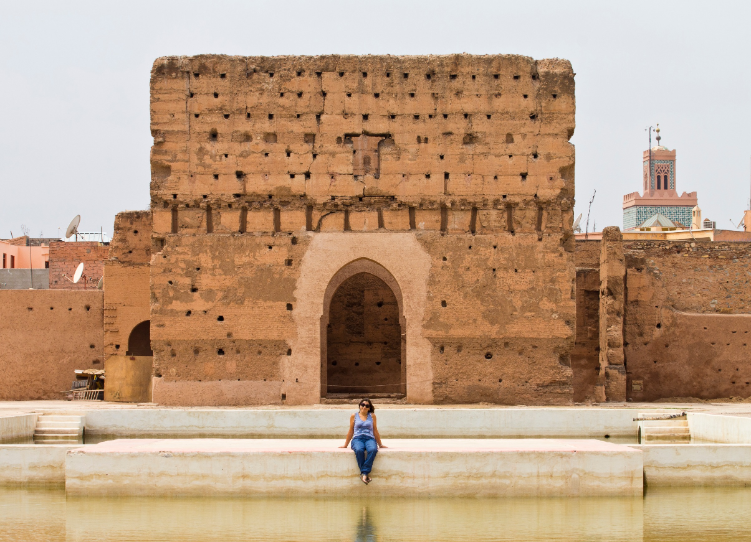
A vast sixteenth-century ruin — sunken gardens, bare walls, storks nesting on the ramparts. Very different in feeling from the restored palaces and good in late afternoon light. The original minbar of the Koutoubia is displayed here.
The twelfth-century minaret is the city’s landmark and its template — the Giralda in Seville is its sibling. Non-Muslims cannot enter, but the gardens beside it are free, shaded and the best place in the medina to sit down.
Marrakech is a city of terraces. A mint tea or a drink on a roof looking at the Koutoubia with the Atlas behind it is, for many visitors, the memory that sticks. Cafés around Jemaa el-Fnaa have the classic view; quieter riads in the northern medina have the better one.
Not a spa treatment — a genuine institution. Black soap, steam, a vigorous scrub with a kessa glove, and a feeling of being new afterwards. Public hammams are cheap and local; riad and spa hammams are gentler and more private. Read our hammam guide so nothing surprises you.
The cobalt-blue garden created by Jacques Majorelle and later owned by Yves Saint Laurent, with the excellent Berber Museum inside it and the YSL museum next door. It is small and extremely popular: book online in advance and go at opening, or you will spend longer queueing than looking.
Actually inside the medina, and a good counterpoint: a restored riad garden built on a classic Islamic four-part plan, with a tower you can climb for a rooftop view over the old city. Much quieter than Majorelle.
A twelfth-century olive grove and reservoir with a pavilion at one end and the Atlas reflected in the water on clear days. Free, huge, and where Marrakchis actually go in the evening. Fifteen minutes by taxi.
The palm grove north of the city: camel rides, quad biking, and some of Marrakech’s best hotels. Our Palmeraie quad bike adventure is the most popular way to see it.
The single best-value half-day in Marrakech. You shop in a local market, then cook a tagine and salads properly, and you leave knowing why Moroccan food tastes the way it does. Our Marrakech cooking class runs in a riad kitchen with a local cook.
Marrakech is a launchpad, and a day out sharpens the days in. The best options, in order of how different they feel:
Our private Marrakech city tour covers the monuments and souks in one well-paced day with a licensed local guide, which is the fastest way to make sense of the medina. Want it combined with a day trip or a cooking class? Tell us your dates and we will build it around them.
Marrakech
From € 30.00 based on 7 person This price is based on 7 travelers. Price varies for different group sizes.
Three full days is the sweet spot: one for the medina monuments and souks, one for the gardens and a cooking class or hammam, and one for a day trip out of the city. Two days covers the highlights; four lets you add Essaouira or the Atlas.
Around 18:00, as the food stalls set up and the light softens, and again after 21:00 for the drum circles and storytellers. The middle of the day is hot, thin and full of touts.
Yes. It is small and extremely popular, so book online ahead of time and arrive at opening. Otherwise you can easily spend longer in the queue than in the garden itself.
The medina is entirely walkable and largely closed to cars, though it is a maze. Anything outside the walls, including Jardin Majorelle, Menara Gardens and the Palmeraie, is better reached by petit taxi.
A cooking class. You shop in a local market, cook a tagine and salads properly, and eat what you make. It is better value and more memorable than most paid attractions, and it explains the food for the rest of your trip.


