Morocco in Winter: What to Expect and Where to Go
Winter is Morocco's most underrated season: empty monuments, low prices, snow on the Atlas and perfect desert days. Here is what to expect and where to go.


Winter is Morocco's most underrated season: empty monuments, low prices, snow on the Atlas and perfect desert days. Here is what to expect and where to go.
Winter in Morocco has a reputation problem. People assume North Africa means heat and are surprised to learn that Marrakech in January is around 18°C by day and 6°C at night, that the High Atlas has a ski resort, and that desert nights can approach freezing. None of that is a reason to stay away. December to February is, for a certain kind of traveller, the best time to come.
| Where | Day | Night | Notes |
|---|---|---|---|
| Marrakech | 18–20°C | 5–8°C | Sunny, dry, cold evenings |
| Merzouga (Sahara) | 19–22°C | 0–5°C | Perfect days, very cold nights |
| Fes | 16–18°C | 4–7°C | Some rain, atmospheric |
| Essaouira | 18–19°C | 11–13°C | Mild, windy, grey spells |
| Chefchaouen | 14–16°C | 5–7°C | Wettest region, occasional snow above |
| Imlil (Atlas) | 8–10°C | −2 to 3°C | Snow above the village |
| Agadir | 21–23°C | 10–12°C | The warmest option |
The crucial detail is the day–night swing. A 20°C afternoon in the desert becomes a near-freezing night four hours later. Almost every winter complaint we hear traces back to someone who packed for the daytime number only.
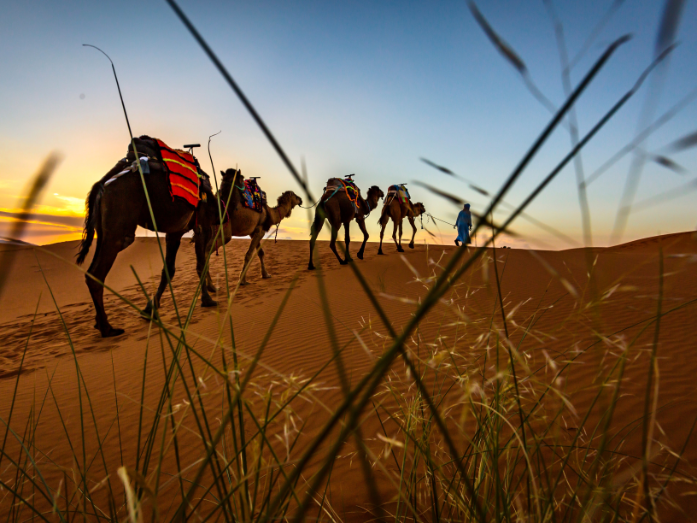
Merzouga, the Dades, Todra Gorge, Ait Ben Haddou and Ouarzazate all have excellent winter weather: sunny, dry and comfortable. The only adjustment is packing warm clothes for the camp night. Our 3-day Sahara tour runs all winter.
Sunny days, cold evenings, quiet monuments and the Atlas on the horizon. Book a riad with heating — many traditional houses have none, and a stone courtyard house at 6°C is genuinely cold. Ask explicitly.
The warmest part of Morocco in winter, at 21–23°C. Also the best surf season at Taghazout, when the Atlantic swell arrives.
Imlil and the valleys are beautiful under snow, and Oukaimeden has a small ski resort about 90 minutes from Marrakech. Village walks are fine; anything high needs gear. Toubkal in winter is a mountaineering route, not a hike — crampons, ice axe and a qualified guide are essential, and people die on it most winters.
The Rif is the wettest part of Morocco and Chefchaouen at 560 m is cold and often rainy in winter, with snow on the peaks above. It is atmospheric and empty, and it is also the one place you may spend a day indoors. Bring a waterproof.
Mild but windy and often grey. Fine for the medina and the ramparts, not for lying on sand.
Marrakech (3 nights, riad with heating) → Ait Ben Haddou and the Dades (1 night) → Merzouga desert camp (1 night) → back via the Draa Valley, with a day in the Atlas at Imlil to see the snow. Seven days, excellent weather throughout, low prices and almost no queues. Add Agadir or Taghazout if you want warmth and surf.
We run the full programme through winter with heated vehicles, camps with proper bedding and drivers who know which passes to avoid after snow. Tell us your dates and we will build the route, or see our multi-day Morocco tours.
Marrakech
From € 140.00 based on 7 person This price is based on 7 travelers. Price varies for different group sizes.
Warm by day in the south and cold at night everywhere. Marrakech runs about 18 to 20 degrees by day and 5 to 8 at night, the Sahara 19 to 22 by day and close to freezing after dark, and Agadir is the warmest at 21 to 23. The day to night swing is the thing to pack for.
Yes, and many people consider it the best season. Days are around 20 degrees rather than 43, so camel treks are comfortable at any hour. Nights can approach freezing, so bring a warm jacket, hat, socks and ideally a thermal base layer.
Yes, in the High Atlas and Middle Atlas and occasionally on the Rif peaks above Chefchaouen. Marrakech itself does not get snow but has a clear view of snow-capped peaks all winter, and there is a small ski resort at Oukaimeden about 90 minutes from the city.
Not always, so ask directly before booking. Traditional riads are stone and tile houses built around open courtyards and can be genuinely cold in January. Some have proper heating, others rely on a brazier or portable heater, and a few have none.
Yes, it is the best value season, with the lowest prices for riads, hotels and tours and almost no queues at monuments. The exception is Christmas and New Year, when prices in Marrakech and Essaouira spike sharply and riads fill early.


