Morocco can be done on very little or spent on generously. Here is a realistic breakdown of what each part of a trip costs, so you can build a budget rather than guess at one.
Morocco is one of the better-value destinations within easy reach of Europe, and it is also a place where the gap between a lean trip and a comfortable one is unusually wide. A backpacker can travel well on very little; the same route with private transport and good riads costs several times as much and feels like a different country. This breakdown is structured by category so you can build a budget rather than pick a single number.
All figures are indicative ranges per person per day in euros, current as a planning guide rather than a quote, and they exclude international flights. Prices in Morocco are quoted in dirhams (MAD).
The three levels
Per person per day
Budget
Mid-range
Comfortable
Accommodation
€10–25
€35–70
€90–250+
Food and drink
€8–15
€20–35
€45–80
Local transport
€3–8
€8–20
€25–60
Activities and entry
€3–8
€10–25
€30–70
Daily total
€25–55
€75–150
€190–450+
Accommodation
Hostel dorm: the cheapest option, widely available in Marrakech, Fes, Essaouira and Chefchaouen.
Simple riad or guesthouse: a private double with breakfast, often beautiful for the money. This is where Morocco is exceptional value.
Good mid-range riad: plunge pool, roof terrace, six to twelve rooms, excellent breakfast.
High-end riad or hotel: genuinely luxurious, still cheaper than equivalents in southern Europe.
Desert camp: a shared-facility tent is inexpensive; an en-suite luxury tent deep in the dunes costs several times more. See our camp comparison.
Riads almost always include breakfast, which meaningfully changes the food budget.
Food and drink
Food is where Morocco is cheapest relative to Europe, if you eat locally.
Street food and local stalls: a bowl of harira, a sandwich or a plate of grilled brochettes costs very little. The Jemaa el-Fnaa stalls, the Fes medina and any local snack shop.
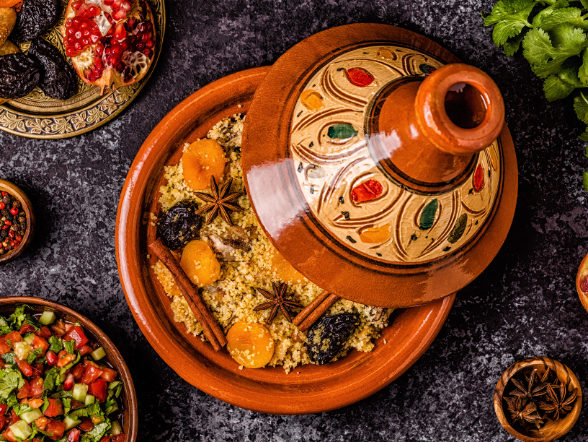
Local restaurant: a tagine or couscous with bread and salad, a few euros.
Tourist restaurant / riad dinner: several times that, usually a set three-course menu.
Upmarket restaurant in Gueliz or a top riad: European prices.
Mint tea: cheap everywhere.
Alcohol: disproportionately expensive. A beer in a licensed bar can cost more than a full tagine. Budget separately if you drink.
Bottled water: very cheap; buy large bottles and refill.
Transport — the biggest variable
This is where budgets diverge most, and where the right choice depends on group size.
Trains (ONCF): excellent value and comfortable, linking Tangier, Rabat, Casablanca, Marrakech, Fes and Meknes. The high-speed Al Boraq between Tangier and Casablanca is genuinely fast. Second class is fine; first class is cheap and gets you a reserved seat.
Intercity buses (CTM, Supratours): cheap, reliable, air-conditioned, and they reach places the train does not — including Merzouga and Essaouira.
Grands taxis: shared long-distance cars, cheap per seat, and they leave when full. Fast and local.
Petits taxis: metered city taxis, very cheap. Insist on the meter.
Car hire: moderate daily rate plus fuel and tolls. Practical, but see the road-safety notes in our safety guide.
Private driver with vehicle: the biggest single line item, and a fixed cost regardless of how many people share it. This is the key arithmetic of Morocco budgeting.
Domestic flights: useful for Dakhla or Laayoune; rarely worth it elsewhere.
The group-size effect
Because a private vehicle costs the same for one person as for six, a private tour that looks unaffordable for a couple often becomes competitive for four and cheap for six. If you are a family or a group of friends, get a private quote before assuming you need a shared minibus — the per-person difference is frequently smaller than people expect, and the trip is much better.
Tours and activities
Monument entry fees: low. Bahia Palace, the Saadian Tombs, Ben Youssef, the Fes medersas — each costs a few euros. Budget a modest daily amount and carry small notes.
Jardin Majorelle: more than most, and worth booking online.
Licensed city guide: a half or full day costs less than most people expect and is the best value purchase of the trip.
Cooking class: half a day including market shopping and the meal you cook. Excellent value.
Hammam: a public hammam costs almost nothing; a spa hammam with scrub and massage is a moderate treat.
Quad biking, camel rides, balloon flights: a balloon flight is the most expensive standard activity in Marrakech and the one people least regret.
3-day shared desert tour: remarkably cheap, and you get what you pay for in vehicle comfort and stop times.
Private multi-day tour: several times a shared tour per person for two travellers, converging quickly as the group grows.
Money practicalities
The dirham is a closed currency — you cannot buy meaningful amounts outside Morocco. Withdraw from ATMs on arrival; they are widespread in cities.
Morocco is a cash economy outside hotels and larger restaurants. Souks, stalls, taxis, guides, camps, tips and small guesthouses are cash.
Small notes matter. Break large notes at supermarkets; getting change in the souks is a recurring friction.
Cards are accepted in hotels, mid-range restaurants and supermarkets, often with a surcharge.
Tipping is expected and modest: a small amount for café service, a little more at restaurants, a note per person for a guide or driver per day, and something for camel handlers and porters.
Bargaining is the norm in souks and for unmetered taxis, not in shops with marked prices. See our souks guide.
Take unspent dirhams to the airport exchange desk before departure; you will want a receipt showing how you obtained them.
A sample week, three ways
Seven days: three nights Marrakech, a 3-day desert trip to Merzouga, one final night. Excluding international flights.
Budget: hostel dorms, street food, a shared minibus desert tour, buses and petits taxis, a handful of monuments. Roughly €200–350 for the week.
Mid-range: a good riad with breakfast, a mix of local and tourist restaurants, a small-group desert tour with a comfort camp, a licensed guide for one day, a cooking class. Roughly €600–1,000.
Comfortable: a high-end riad, a private vehicle and driver–guide throughout, an en-suite luxury desert camp, a balloon flight, spa hammam and good restaurants. From roughly €1,500 upward, with no real ceiling.
Five ways to save without spoiling the trip
Travel in low season. November and January–February cut accommodation costs substantially and the weather in the south is excellent.
Eat local at lunch, treat yourself at dinner. A stall lunch and a riad dinner is the best value pattern in Morocco.
Use trains and CTM buses between cities and save the private vehicle for the desert route, where it genuinely earns its cost.
Fill the vehicle. Travelling as four rather than two roughly halves the per-person transport cost on a private tour.
Stay in riads with breakfast included — nearly all do, and it removes a meal from the budget.
Get a real number
Ranges only go so far. Tell us your dates, group size and the standard of accommodation you want and we will quote the actual figure, including where we think you should spend more and where you should not. Ask for a free quote, or see our multi-day Morocco tours.
From € 789.87
based on 7 personThis price is based on 7 travelers. Price varies for different group sizes.
Frequently Asked Questions
How much does a week in Morocco cost?
Excluding international flights, roughly 200 to 350 euros per person for a budget week with hostels and shared tours, 600 to 1,000 for a mid-range week with a good riad and a small-group desert trip, and from about 1,500 upward for a private vehicle, driver-guide and luxury desert camp.
Is Morocco cheap to travel in?
Food and local transport are very cheap by European standards, and mid-range riads are excellent value. The expensive elements are private transport, alcohol and high-end desert camps. A lean trip and a comfortable one differ by a factor of five or more.
Why do private tours cost so much more per person for two people?
Because the vehicle and driver are a fixed cost regardless of occupancy. Two people carry the whole cost; four roughly halve it each and six reduce it further. If you are a family or a group, get a private quote before assuming you need a shared minibus.
Do I need cash in Morocco or can I use cards?
You need cash. Hotels, mid-range restaurants and supermarkets take cards, but souks, stalls, taxis, guides, desert camps and tips are cash only. The dirham is a closed currency, so withdraw from an ATM on arrival and keep plenty of small notes.
What is the best value thing to spend money on in Morocco?
A licensed local guide for one morning in Marrakech or Fes. It costs a fraction of most activities and transforms your understanding of a medina that is otherwise bewildering. A cooking class is a close second.