A 14-Day Morocco Itinerary: The Ultimate Grand Tour
Two weeks lets you do Morocco as a loop rather than a line: the imperial cities, the Rif, the Sahara, the Atlas and the Atlantic coast, without rushing any of them.


Two weeks lets you do Morocco as a loop rather than a line: the imperial cities, the Rif, the Sahara, the Atlas and the Atlantic coast, without rushing any of them.
Fourteen days is the length at which Morocco stops requiring compromises. You can see all four imperial cities, spend a night in the Sahara, cross the High Atlas, walk in the mountains and finish on the Atlantic coast — and still have days with nothing scheduled. This is the grand tour route, running north to south so the trip builds rather than winds down.
| Day | Where | Night | Driving |
|---|---|---|---|
| 1 | Arrive Casablanca | Casablanca | — |
| 2 | Hassan II Mosque, then Rabat | Rabat | 1.5 h |
| 3 | Rabat, then north to Chefchaouen | Chefchaouen | 4 h |
| 4 | Chefchaouen: medina, Spanish Mosque | Chefchaouen | — |
| 5 | Akchour falls, then Fes | Fes | 3.5 h |
| 6 | Fes: guided medina day | Fes | — |
| 7 | Volubilis, Moulay Idriss, Meknes | Fes | 3 h |
| 8 | Ifrane, cedar forest, Ziz Valley, Merzouga | Desert camp | 7 h |
| 9 | Dunes, Rissani, Todra Gorge | Todra / Tinghir | 3 h |
| 10 | Dades Valley, Ouarzazate, Ait Ben Haddou | Ait Ben Haddou | 4 h |
| 11 | Tichka pass to Marrakech | Marrakech | 4 h |
| 12 | Marrakech medina and monuments | Marrakech | — |
| 13 | Atlas day trip or Essaouira transfer | Marrakech / Essaouira | 2–3 h |
| 14 | Free morning, depart Marrakech | — | — |
In to Casablanca, out of Marrakech. No road driven twice, and the longest day is seven hours.
Land in Casablanca — it has Morocco’s widest choice of international flights, which is the main reason to start here. The Hassan II Mosque is one of very few mosques in Morocco that non-Muslims can enter, and it is genuinely world class: a 210 m minaret, a retractable roof, and a prayer hall built partly over the Atlantic. Add the Art Deco downtown around Place Mohammed V and the Habous quarter. See our Casablanca guide.
Then 90 minutes to Rabat, the capital and the most relaxed of the imperial cities: the Kasbah of the Udayas above the river estuary, the twelfth-century Hassan Tower and the Mausoleum of Mohammed V, the Roman and Merenid site of Chellah, and a small walkable medina.
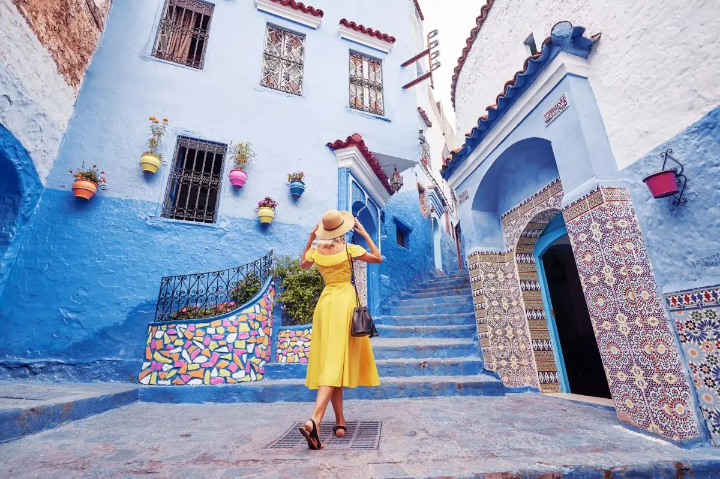
North to the blue town, roughly four hours. Two nights here is the right amount — enough for the medina, the Spanish Mosque at sunset, the Kasbah, and the empty lanes at dawn before the Tangier coaches arrive.
With two weeks you also get the thing day visitors never see: the Akchour waterfalls in Talassemtane National Park, 30 minutes from town. The lower falls are about an hour’s walk each way; the rock arch known as God’s Bridge is a harder half-day. Do this on the morning of day 5, then drive to Fes.
Day 6 — a full guided day in Fes el-Bali. The Al-Attarine and Bou Inania medersas are the finest small buildings in Morocco; the Chouara tanneries are best in the morning; Al-Qarawiyyin has been teaching since 859. A licensed guide is close to essential in a medina of roughly 9,000 unsigned lanes.
Day 7 — the day trip to Volubilis, the best Roman site in Morocco with its mosaics still in the houses they were made for, plus the pilgrimage town of Moulay Idriss and the imperial capital of Meknes with Bab Mansour and the vast royal granaries at Heri es-Souani.
~7 hours, the longest day, and better than it sounds. Up into the Middle Atlas via Ifrane, the 1930s hill station, and the cedar forests near Azrou with their Barbary macaques. Lunch at Midelt, then the Ziz Valley — a canyon filled with hundreds of thousands of date palms, with one of the best free viewpoints in the country. Erfoud, then Merzouga in the late afternoon.
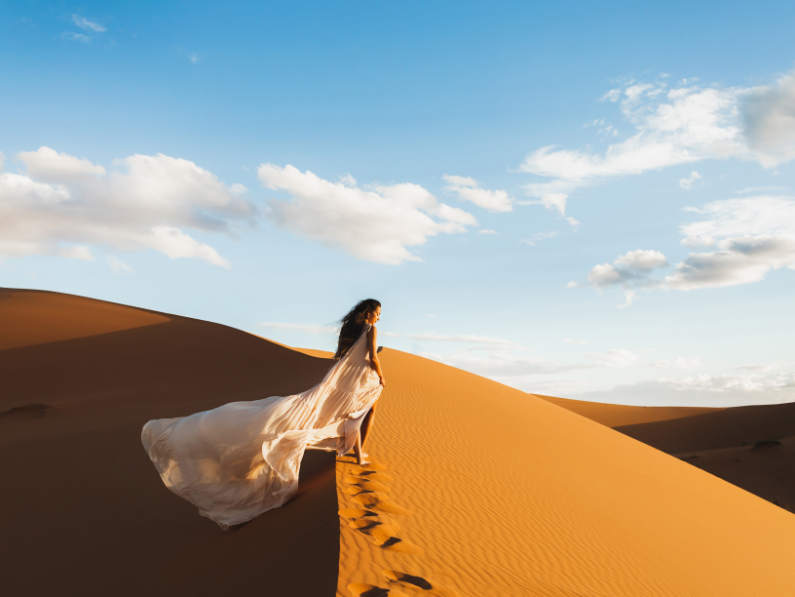
Camel trek into Erg Chebbi about 90 minutes before sunset, dinner at camp, and a night under a sky with no light pollution in it.
~3 hours driving — a genuinely easy day. Sunrise on the dunes, breakfast, and time to do things shorter itineraries skip: the Gnaoua musicians of Khamlia village, the Rissani market if it falls on a Sunday, Tuesday or Thursday, or a 4x4 run out to the nomad encampments and the dry Lake Merzouga.
Afternoon to Todra Gorge, where limestone walls several hundred metres high narrow to roughly ten metres. Arrive with time to walk the canyon floor in the late light, and stay in Tinghir or the gorge itself. See our Todra and Dades guide.
~4 hours. West through the Dades Gorge — the switchbacks above Ait Oudinar, the “monkey fingers” rock formations, kasbah villages — then the Valley of a Thousand Kasbahs, the rose-growing town of Kelaa M’Gouna, and Ouarzazate with its Taourirt Kasbah and film studios.
Sleep at Ait Ben Haddou rather than passing through it. This is one of the best decisions in the whole itinerary: the ksar at sunset and at dawn, with no coaches, from a guesthouse terrace opposite. Almost no short itinerary allows it.
~4 hours. Morning at the ksar and the climb to the granary, an optional detour to Telouet Kasbah, then the Tizi n’Tichka pass at around 2,260 m and down into Marrakech. Arrive mid-afternoon with the evening free for Jemaa el-Fnaa.
Day 12 — the medina from opening time: Bahia Palace, the Saadian Tombs, Medersa Ben Youssef, the souks, then a hammam or Jardin Majorelle, and a rooftop dinner.
Day 13 — choose your ending:
Day 14 — a free morning for last shopping, then fly from Marrakech Menara.
Fourteen days gives real room, and the right shape depends on your flights, your pace and what you care about most. Tell us your dates and we will lay out the whole route, or browse our multi-day Morocco tours.
Casablanca
From € 1260.00 based on 7 person This price is based on 7 travelers. Price varies for different group sizes.
Tangier
From € 1175.00 based on 7 person This price is based on 7 travelers. Price varies for different group sizes.
All four imperial cities, Chefchaouen and the Rif, a night in the Sahara at Merzouga, Todra Gorge and the Dades Valley, Ait Ben Haddou, the High Atlas and the Atlantic coast, with a couple of days unscheduled. Two weeks is the length at which Morocco stops requiring compromises.
About 32 hours in total. The longest single day is roughly seven hours from Fes to Merzouga, and four days have no transfer at all. Spread across two weeks that is comfortable.
Either, and flights should decide. Casablanca has the widest choice of international routes and sits well for a north-to-south run finishing in Marrakech. Reversing it works just as well.
Yes, and it is one of the best decisions in a 14-day plan. Staying overnight gets you the ksar at sunset and again at dawn with no coaches, from a guesthouse terrace opposite. Short itineraries never allow this.
Layers for four climates: the mild Atlantic coast, the cool wet Rif, the Sahara with cold nights, and the High Atlas. Bring a warm jacket, a waterproof, proper walking shoes and modest clothing for the medinas and the mosque in Casablanca.


